.png)

Essential Beginner Chords Every Guitarist Should Learn

Mastering a handful of beginner chords opens the door to playing countless songs and builds a solid foundation for your guitar journey. This guide walks you through the essential chords every beginner should learn, with practical tips to help you play them cleanly and confidently.

Why Start with Beginner Chords
Chords are the building blocks of most songs. When you learn chords, you can play rhythm parts, accompany singers, and jam with other musicians. Beginner chords are usually simple shapes that use just a few fingers and open strings. These chords sound good and are easier to switch between, which helps you develop finger strength and coordination.
Focusing on beginner chords first prevents frustration and keeps your practice sessions productive. Once you feel comfortable with these chords, you can explore more complex shapes and techniques.
The Most Important Beginner Chords to Learn
Here are the key chords that form the backbone of many popular songs. Practice these until you can play each one clearly and switch between them smoothly.
1. E Minor (Em)
2. E Major (E)
3. A Major (A)
4. A Minor (Am)
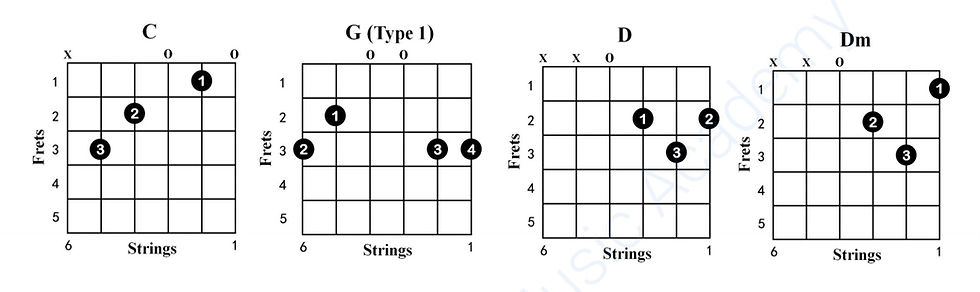
5. C Major (C)
6. G Major (G)
7. D Major (D)
8. D Minor (Dm)

Tips for Practicing Beginner Chords
First, hold a chord and pick each string individually to ensure all the strings are ringing out clearly.
If a particular string is not ringing clearly, the reasons could be the following
Finger tips are not pressing hard enough on the fretboard
Left hand finger nails are touching the fretboard
Fingers or palm may be touching any of the open strings
Next, strum the chord with downstrokes to hear its tone.
Position Your Fingers Correctly
Place your fingertips close to the fret, not on top of it. This reduces buzzing and makes the chord sound clearer. Keep your thumb behind the neck for support.
Strum Slowly and Clearly
Start by strumming one string at a time to check if each note rings out clearly. If a string sounds muted or buzzy, adjust your finger placement.
Practice Switching Between Chords
Switching chords smoothly is key to playing songs. Practice moving from one chord to another slowly, then increase speed as you improve.
Use a Metronome
Playing with a metronome helps build timing and rhythm. Start slow and gradually increase the tempo.
Be Patient and Consistent
Finger strength and muscle memory take time to develop. Short, daily practice sessions are more effective than long, infrequent ones.
How to Use These Chords in Songs
Many popular songs use just a few of these beginner chords. For example:
"Horse with No Name" by America uses Em and D6add9/F# (a variation of Em).
"Knockin' on Heaven's Door" by Bob Dylan uses G, D, Am, and C.
"Wonderwall" by Oasis uses Em, G, D, and A7sus4 (a variation of A).
Start by learning simple songs that use these chords to build confidence and enjoy playing music early on.
Common Challenges and How to Overcome Them
Finger Pain and Soreness
It’s normal to feel soreness when starting. Build calluses by practicing regularly but take breaks if pain is sharp.
Muted or Buzzing Strings
Check finger placement and press firmly. Avoid touching adjacent strings accidentally.
Difficulty Switching Chords
Slow down and focus on accuracy. Practice chord changes in small sequences.
Strumming Patterns
Start with simple downstrokes. Once comfortable, add upstrokes and varied rhythms.
🎸 Online Guitar Classes
Want to learn guitar through a structured program under the guidance of expert instructors? Join our Online Guitar Classes at BGMA and learn from the comfort of your home.


Comments